If you’ve been dealing with back pain, a herniated disc, or sciatica, you may have come across a treatment called spinal decompression therapy.
The name sounds technical, but the basic idea is relatively simple.
Spinal decompression therapy uses controlled traction to gently pull on the spine. The aim is to temporarily reduce mechanical loading on certain spinal structures, which may help relieve symptoms in selected patients.
But what actually happens during a session? Does it hurt? And how is it different from ordinary chiropractic treatment?
This guide explains how non-surgical spinal decompression works, what the equipment does, and what you should know before considering treatment.
What Is Spinal Decompression Therapy?
Spinal decompression therapy is a term commonly used to describe a form of mechanical spinal traction.
During treatment, a specialised table or device applies a controlled pulling force to the spine.
The traction may be continuous or alternate between periods of pulling and relaxation.
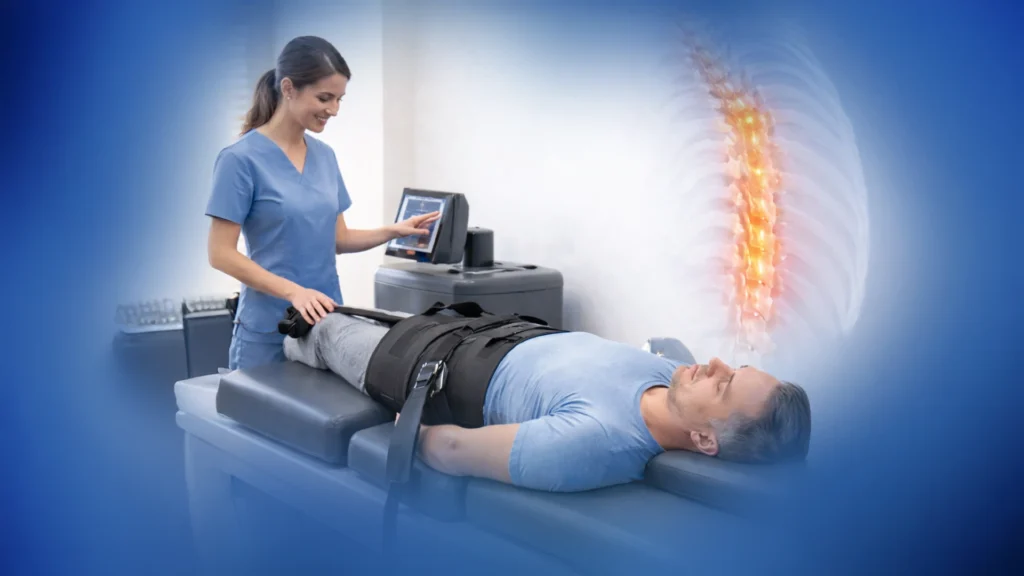
Non-surgical spinal decompression is usually performed while the patient lies on a treatment table, sometimes secured with a harness or other positioning equipment.
The purpose is to change the mechanical forces acting on the spine temporarily.
Spinal decompression is sometimes considered for people with certain types of back or neck pain, including some disc-related conditions.
However, it is not appropriate for every patient, and research has not established that it consistently provides better outcomes than other conservative treatments.
How Does Spinal Decompression Therapy Work?
Spinal decompression equipment applies traction to the spine using controlled mechanical force.
Here is how the process generally works.
Step 1: Assessment Before Treatment
Before a session, the healthcare professional should review your symptoms and medical history.
This may include questions about:
- Where your pain occurs
- Whether pain travels into an arm or leg
- Previous spinal injuries or surgery
- Existing medical conditions
- Numbness or weakness
- Treatments you have already tried
A physical examination may also be appropriate.
The purpose is to determine whether traction could be suitable and whether any symptoms require medical investigation.
Step 2: Positioning on the Treatment Table
You are positioned on a spinal decompression table, usually lying on your back or stomach depending on the equipment and treatment approach.
A harness or support system may be used to help maintain your position.
The clinician should explain the setup and check that you are comfortable before beginning.
Step 3: Applying Controlled Traction
The equipment gradually applies a pulling force to the spine.
Some devices alternate between traction and relaxation phases.
The settings may be adjusted according to the treatment area, patient characteristics, symptoms and equipment protocol.
You may feel a gentle pulling or stretching sensation.
Step 4: Monitoring Your Response
During the session, your provider should monitor how you respond.
If you experience sharp pain, increasing leg symptoms, numbness or other concerning discomfort, treatment should be stopped and reassessed.
The goal is not to push through pain or use the highest possible traction force.
Step 5: Reviewing Symptoms Afterward
After the session, the clinician may ask whether your symptoms changed.
Some patients report temporary relief, while others notice no meaningful difference or experience soreness.
Your response should help guide whether continuing treatment is appropriate.
What Does a Spinal Decompression Table Actually Do?
A spinal decompression table is designed to apply mechanical traction in a controlled way.
Depending on the model, it may include:
- A motorised pulling system
- Adjustable traction settings
- Harnesses or positioning supports
- Timed pulling and relaxation cycles
- Controls that allow the clinician to adjust or stop treatment
Some devices are marketed as computerised spinal decompression systems.
Although these systems may offer precise control over traction settings, advanced equipment does not automatically mean that a treatment produces better clinical outcomes.
The important considerations are patient suitability, appropriate assessment, treatment monitoring and realistic expectations.
What Is the Difference Between Spinal Decompression and Spinal Traction?
The terms are often used interchangeably in non-surgical settings.
Spinal traction is the broader term for applying a pulling force to the spine.
Non-surgical spinal decompression is commonly used to describe specialised or motorised traction systems that apply controlled pulling forces, sometimes in repeated cycles.
Manufacturers may describe differences in equipment design, positioning or traction patterns.
However, strong clinical evidence has not established that branded decompression systems consistently outperform other forms of mechanical traction.
Both approaches should be considered within the broader context of a patient’s diagnosis and available treatment options.
What Conditions Is Spinal Decompression Used For?
Non-surgical spinal decompression is sometimes considered for patients experiencing certain spinal or musculoskeletal symptoms.
These may include:
Herniated or Bulging Discs
A disc can sometimes irritate nearby nerves and contribute to back or leg pain.
Traction may be considered in selected cases, although it has not been reliably shown to reverse a herniated disc.
Sciatica
Sciatica commonly involves pain travelling from the lower back into the buttock or leg.
Mechanical traction has been studied for nerve-related symptoms, but results are mixed, and routine use is not recommended by all clinical guidelines.
Learn more about sciatica and its possible causes.
Chronic Lower Back Pain
Some people with persistent back pain explore traction as part of a broader conservative care plan.
However, exercise-based rehabilitation and other established approaches are often important components of treatment.
Neck Pain
Certain traction devices are designed for the cervical spine.
The suitability and potential benefit of cervical traction depend on the specific condition and clinical findings.
For more information about common spinal conditions, visit our back pain and neck pain pages.
Does Spinal Decompression Actually Stretch the Spine?
Yes, mechanical traction applies a pulling force to the spine.
This can temporarily change loading on spinal structures.
However, that does not mean the spine becomes permanently longer or that damaged discs automatically return to their original condition.
You may see claims that spinal decompression creates negative pressure inside discs, pulls herniated material back into place or restores disc nutrients.
While these mechanisms are sometimes proposed, they should not be presented as reliably proven clinical outcomes.
Symptom improvement, when it occurs, does not necessarily demonstrate that a disc has physically healed or retracted.
What Does Spinal Decompression Feel Like?
During treatment, you may notice a gradual pulling or stretching sensation.
Some people find the experience comfortable, while others may feel pressure or discomfort.
The sensation depends on the equipment, treatment settings and your individual symptoms.
A spinal decompression session should not require you to tolerate severe pain.
Tell your provider immediately if you notice:
- Sharp or increasing pain
- Pain travelling farther into an arm or leg
- New tingling or numbness
- Dizziness
- Any unusual or concerning sensation
Your clinician should be able to adjust or stop the procedure.
How Long Does a Spinal Decompression Session Take?
Session length varies depending on the equipment, clinical approach and treatment plan.
Some protocols use sessions lasting approximately 15–30 minutes, although this is not a universal standard.
The initial appointment may take longer because it includes an assessment and discussion of treatment options.
Your provider should explain the expected session length before treatment begins.
How Many Spinal Decompression Sessions Will I Need?
There is no universally established number of sessions that works for every patient.
Some clinics use multi-session treatment programmes, but the ideal frequency and duration have not been firmly established for all conditions.
Before committing to a course of treatment, ask:
- Why is this treatment recommended for my condition?
- What improvement should we look for?
- When will my progress be reviewed?
- What happens if symptoms do not improve?
- What alternatives are available?
A treatment plan should be reviewed according to your response rather than continuing automatically.
What Are the Potential Benefits and Limitations?
It is useful to understand both sides before considering treatment.
| Potential advantages | Important limitations |
| Non-surgical procedure | Does not replace surgery when surgery is medically necessary |
| Does not require an incision or general anaesthesia | Can still cause discomfort or worsen symptoms |
| May provide temporary relief for some patients | Benefits are not consistent across studies |
| Traction settings can be adjusted | Not appropriate for every spinal condition |
| May be considered within conservative care | Disc healing and permanent correction are not established outcomes |
For many people with back pain, other approaches such as physical activity, exercise-based rehabilitation and appropriate medical management may be considered first.
Is Spinal Decompression Therapy Safe?
Non-surgical spinal decompression may be suitable for some patients, but it is not risk-free.
Certain conditions may make traction inappropriate or require specialist clearance, including:
- Severe osteoporosis
- Spinal fractures
- Spinal instability
- Certain spinal implants or previous operations
- Spinal infection or tumour
- Significant neurological deficits
- Certain pregnancy-related circumstances
Possible side effects include temporary soreness, increased back pain or aggravated nerve symptoms.
A thorough assessment is important before treatment.
For a more detailed explanation, read our guide: Is Spinal Decompression Safe? Risks, Side Effects & Who Should Avoid It.
Spinal Decompression vs Chiropractic Adjustments
Although both may be offered in chiropractic settings, they are different procedures.
Spinal decompression uses sustained or intermittent traction to apply a pulling force to the spine.
Chiropractic adjustments involve manually or instrumentally applied forces to spinal or other joints.
Neither procedure is appropriate for every patient.
A clinician may recommend exercise, education, manual therapy or another approach depending on the diagnosis and individual circumstances.
Learn more about chiropractic care and the clinic’s available services.
What Happens After a Spinal Decompression Session?
After a session, you may be able to resume ordinary light activities, depending on your symptoms and the clinician’s advice.
Some people experience temporary soreness or stiffness.
Your provider may recommend comfortable movement, activity adjustments or appropriate exercises as part of a broader care plan.
If symptoms become significantly worse, or you develop new numbness or weakness, contact a healthcare professional promptly.
New bladder or bowel dysfunction, numbness around the groin, or rapidly worsening leg weakness requires emergency medical assessment.
Is Spinal Decompression the Same as Surgery?
No.
Non-surgical spinal decompression uses traction applied externally to the body.
Surgical decompression involves an operation intended to relieve pressure on specific spinal structures, often nerves.
Examples of surgical decompression procedures include laminectomy and discectomy.
Surgery may be appropriate for selected patients, particularly when significant nerve compression or progressive neurological problems are present.
Non-surgical traction should not be viewed as an equivalent replacement for medically indicated surgery.
How Much Does Spinal Decompression Therapy Cost?
The cost depends on the clinic, location, equipment, number of sessions and treatment plan.
Before beginning treatment, ask for a clear explanation of:
- The cost per session
- The proposed number of sessions
- Any additional assessment fees
- Whether other treatments are included
- Cancellation or package policies
- Insurance coverage and out-of-pocket expenses
Insurance coverage varies, and some plans may not cover non-surgical spinal decompression.
Contact your insurer and the clinic to confirm benefits rather than assuming treatment will be reimbursed.
Spinal Decompression Therapy in Sanford, FL
If you’re exploring non-surgical spinal decompression, a consultation can help you understand whether the procedure may be appropriate for your symptoms.
At VitalSpine Chiropractic in Sanford, FL, Dr. Michaelene Callahan, DC, offers spinal decompression as part of the clinic’s available services.
A consultation should consider your medical history, symptoms, examination findings, possible contraindications and other treatment options.
You can learn more about the clinic’s advanced spinal decompression service.
To discuss your options, contact VitalSpine Chiropractic.
Frequently Asked Questions
1. Is spinal decompression therapy the same as traction?
Non-surgical spinal decompression is generally a form of mechanical traction. Some devices use specialised computerised controls or alternating traction cycles, but evidence has not consistently demonstrated that branded decompression systems provide better outcomes than other traction methods.
2. Can spinal decompression permanently fix a herniated disc?
There is not strong evidence that non-surgical spinal decompression reliably repairs or permanently reverses a herniated disc. Some patients may experience symptom improvement, but that does not necessarily mean the disc has physically returned to its previous condition.
3. Do you need an MRI before spinal decompression?
Not everyone needs an MRI. Imaging decisions depend on symptoms, examination findings, medical history and whether the results would change clinical management. Some warning signs require medical investigation before treatment.
4. Can you drive after a spinal decompression session?
Many people may be able to drive afterward if they feel well and have no limiting symptoms. However, follow your clinician’s advice, particularly if you experience pain, dizziness or weakness.
5. Can spinal decompression be combined with exercise?
A clinician may recommend suitable exercises or rehabilitation alongside other conservative treatments. The appropriate combination depends on your condition, symptoms and response to care.
Disclaimer
This article is for general educational purposes and does not replace professional medical advice, diagnosis or treatment. Spinal decompression is not suitable for everyone, and treatment decisions should be based on an individual assessment by a qualified healthcare professional.