
If you’re living with a herniated disc, sciatica, or persistent back pain, you may have started researching different ways to find relief.
Two options you might come across are non-surgical spinal decompression therapy and spinal decompression surgery.
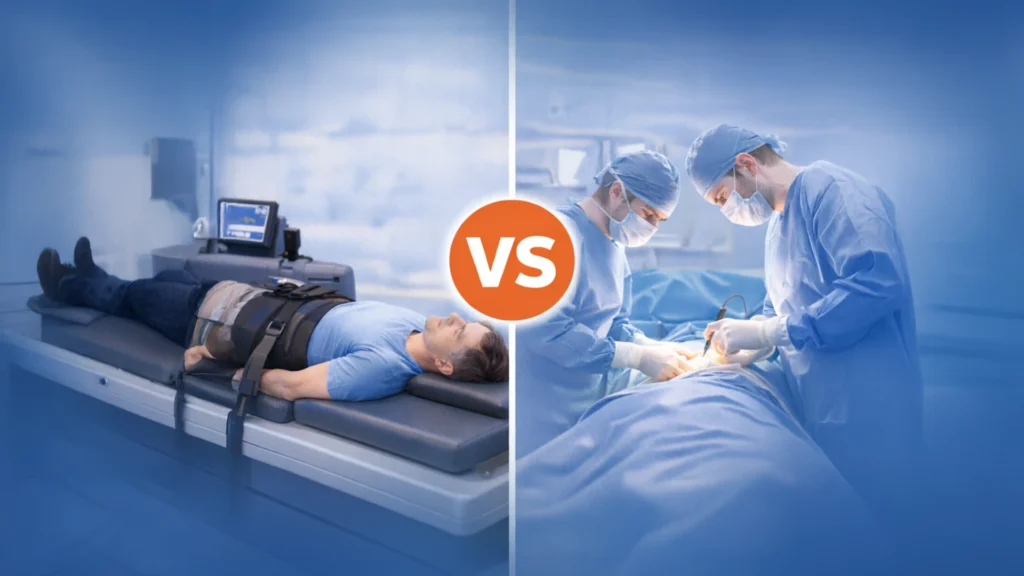
They sound similar, but spinal decompression and surgery are very different approaches.
One uses controlled traction to apply a pulling force to the spine. The other involves an operation to relieve pressure on specific spinal nerves or structures.
Understanding the differences can help you ask better questions, set realistic expectations, and discuss suitable options with your healthcare provider.
What Is Non-Surgical Spinal Decompression?
Non-surgical spinal decompression is a form of mechanical traction.
During treatment, you usually lie on a specialised table while a device applies controlled pulling forces to the spine.
Some systems alternate between periods of traction and relaxation.
The aim is to temporarily change mechanical loading on spinal structures.
Non-surgical decompression is sometimes considered for certain types of back or neck pain, including some disc-related conditions.
However, it is not suitable for everyone, and evidence of its effectiveness is mixed.
Claims that traction reliably pulls herniated discs back into place or permanently repairs damaged discs have not been established by strong clinical evidence.
For a step-by-step explanation of the procedure, read our guide to what spinal decompression therapy is.
What Is Spinal Decompression Surgery?
Spinal decompression surgery involves an operation to relieve pressure on spinal nerves or other structures.
A surgeon may remove part of a disc, bone, or other tissue that is compressing a nerve.
Common procedures include:
Discectomy
A discectomy removes part of a herniated disc that is pressing on a nerve.
It may be considered for selected patients with persistent or severe nerve-related symptoms.
Laminectomy
A laminectomy removes part of the bony arch at the back of a vertebra to create more space for nerves.
It is sometimes performed for spinal stenosis.
Foraminotomy
A foraminotomy enlarges the opening through which a spinal nerve exits the spine.
It may be used when narrowing in this area contributes to nerve compression.
Spinal Fusion
Spinal fusion joins two or more vertebrae to provide stability.
It is not simply another name for decompression surgery, although it may sometimes be performed alongside decompression when there is an appropriate indication.
The recommended procedure depends on the diagnosis, symptoms, imaging findings, and overall health.
Spinal Decompression vs Surgery: Key Differences
| Feature | Non-surgical spinal decompression | Spinal decompression surgery |
| Approach | External mechanical traction | Operation involving spinal structures |
| Incisions | None | Usually required |
| Anaesthesia | Generally not required | Often required |
| Main goal | Temporarily change mechanical loading | Relieve identified structural nerve compression |
| Recovery | Usually little procedural downtime | Varies from weeks to months depending on procedure |
| Risks | Soreness, increased pain or aggravated symptoms | Infection, bleeding, nerve injury, anaesthetic and other surgical risks |
| Evidence | Mixed for low back pain; routine traction not recommended by several guidelines | Can be effective for selected conditions with appropriate indications |
| Suitable for everyone? | No | No |
Important: These are not interchangeable treatments. Non-surgical traction cannot reliably replace an operation when significant nerve compression or another urgent surgical condition is present.
Which Treatment Is More Effective?
The answer depends on the underlying condition.
For uncomplicated low back pain, surgery is often unnecessary. Many people improve with time, activity guidance, exercise-based rehabilitation, and other conservative care.
However, non-surgical spinal decompression has not been consistently shown to outperform other conservative treatments for general low back pain.
For selected patients with confirmed nerve compression, such as certain cases of lumbar disc herniation or spinal stenosis, surgery may provide meaningful improvements in pain or function.
The expected benefit depends on the condition being treated and the patient’s circumstances.
It is therefore misleading to say that one approach is always more effective than the other.
The better question is: What condition is causing the symptoms, and which treatments have evidence of benefit for that condition?
Is Non-Surgical Spinal Decompression Safer Than Surgery?
Non-surgical spinal decompression avoids risks associated with an operation, including incisions, general anaesthesia, and certain surgical complications.
However, it still has potential risks.
Some patients may experience:
- Temporary soreness
- Increased back or neck pain
- Worsening arm or leg symptoms
- Discomfort from positioning or traction equipment
Traction may be inappropriate for people with certain spinal fractures, severe osteoporosis, instability, or other medical conditions.
Surgery carries additional risks, but it may also provide benefits that traction cannot achieve in patients with specific structural problems.
For a detailed discussion of traction risks and contraindications, read Is Spinal Decompression Safe?.
How Does Recovery Compare?
Recovery After Non-Surgical Spinal Decompression
Because traction does not involve an incision or anaesthesia, patients generally do not need a surgical recovery period.
Some people can resume ordinary light activities afterward, depending on their symptoms.
However, they may experience soreness or require adjustments to their activities.
If a clinic recommends multiple sessions, the treatment schedule should be explained and reviewed according to the patient’s response.
Recovery After Spinal Decompression Surgery
Surgical recovery varies considerably.
A minimally invasive discectomy may involve a shorter recovery than a more extensive procedure involving several spinal levels or fusion.
Recovery may include:
- Temporary activity restrictions
- Wound care
- Pain management
- Gradual return to work
- Physical rehabilitation
- Follow-up appointments
Some patients recover over several weeks, while others need months.
Your surgeon can explain the expected recovery for the specific procedure being considered.
What About the Cost of Spinal Decompression vs Surgery?
Non-surgical traction usually involves lower costs per treatment session than an operation.
However, a recommended course may include multiple appointments, and the total cost depends on the clinic and treatment plan.
Spinal surgery can involve surgeon and facility fees, anaesthesia, imaging, hospital care, and rehabilitation.
Insurance coverage also varies.
A direct cost comparison is not always meaningful because the treatments may be recommended for different conditions.
Before making a decision, ask for an itemised estimate and confirm your insurance benefits.
When Might Non-Surgical Spinal Decompression Be Considered?
Mechanical traction may be considered in selected circumstances after a qualified professional evaluates the patient’s symptoms and medical history.
Factors that may be reviewed include:
- The suspected source of pain
- Whether symptoms involve nerve irritation
- Previous treatment responses
- Bone health
- Spinal stability
- Previous surgery
- Potential contraindications
However, traction is not a standard first-line recommendation for every patient with back pain, sciatica, or a herniated disc.
Other conservative treatments may have stronger supporting evidence depending on the diagnosis.
For more options, see our article on back pain treatment without surgery.
When Might Spinal Decompression Surgery Be Necessary?
Surgery may be recommended when a specific structural condition is causing significant symptoms and the expected benefits outweigh the risks.
Examples include selected cases of:
- Persistent nerve compression with disabling symptoms
- Progressive neurological weakness
- Spinal stenosis causing significant functional limitations
- Certain spinal injuries or unstable conditions
- Cauda equina syndrome
Emergency Warning Signs
Seek emergency medical attention if you develop:
- New loss of bladder or bowel control
- Difficulty urinating with new neurological symptoms
- Numbness around the groin or inner thighs
- Rapidly worsening weakness in one or both legs
These symptoms may indicate serious nerve compression.
Do not delay urgent medical evaluation to try a course of non-surgical spinal decompression.
Can You Try Conservative Care Before Considering Surgery?
In many non-emergency situations, conservative care is considered before surgery.
Depending on the diagnosis, this may include:
- Staying appropriately active
- Exercise-based rehabilitation
- Physical therapy
- Medication when suitable
- Selected manual therapies
- Other condition-specific treatments
Some people improve sufficiently without surgery.
However, delaying surgery is not always appropriate, particularly when neurological function is deteriorating or another urgent condition is present.
A medical specialist can help explain the expected benefits and risks of waiting versus proceeding with an operation.
Questions to Ask Before Choosing a Treatment
If you’re comparing spinal decompression therapy with surgery, consider discussing these questions with your healthcare provider:
- What is the most likely cause of my symptoms?
- Do my examination findings suggest nerve compression?
- Is imaging necessary to guide treatment?
- What treatments have the strongest evidence for my condition?
- What are the risks of delaying surgery, if surgery has been recommended?
- What improvements should I realistically expect?
- How will we measure whether a treatment is working?
- What happens if my symptoms do not improve?
A well-informed decision should consider both medical evidence and your personal circumstances.
Exploring Non-Surgical Spinal Care in Sanford, FL
At VitalSpine Chiropractic in Sanford, FL, Dr. Michaelene Callahan, DC, offers chiropractic care and non-surgical spinal decompression as part of the clinic’s available services.
A consultation can help determine whether your symptoms may be suitable for conservative musculoskeletal care or whether further medical evaluation is needed.
If surgery has already been recommended, discuss any proposed alternative treatment with your treating surgeon or relevant medical specialist before delaying the recommended procedure.
To learn more about the clinic’s services, visit the advanced spinal decompression page.
You can also contact VitalSpine Chiropractic.
Frequently Asked Questions
1. Is non-surgical spinal decompression the same as spinal decompression surgery?
No. Non-surgical decompression uses external traction, while surgery involves physically relieving pressure on specific spinal structures through an operation.
2. Can non-surgical spinal decompression prevent the need for surgery?
There is insufficient strong evidence to claim that non-surgical spinal decompression reliably prevents surgery. Some patients improve with conservative care, but improvement cannot necessarily be attributed to traction alone.
3. Is spinal decompression surgery always a major operation?
No. The complexity varies. Some decompression procedures are relatively limited, while others involve multiple spinal levels or additional stabilisation. Recovery and risks depend on the procedure and patient.
4. Can a herniated disc heal without surgery?
Yes. Many people with symptomatic lumbar disc herniation improve over time without surgery. However, significant or progressive neurological problems may require urgent specialist assessment.
5. Should I get a second opinion before spinal surgery?
For non-emergency surgery, a second opinion may help you understand the diagnosis, available options, expected outcomes, and risks. Do not delay emergency care to obtain a routine second opinion.
Disclaimer
This article is for general educational purposes and does not replace professional medical advice, diagnosis, or treatment. Decisions about spinal surgery or non-surgical care should be made with qualified healthcare professionals who understand your individual condition.


