
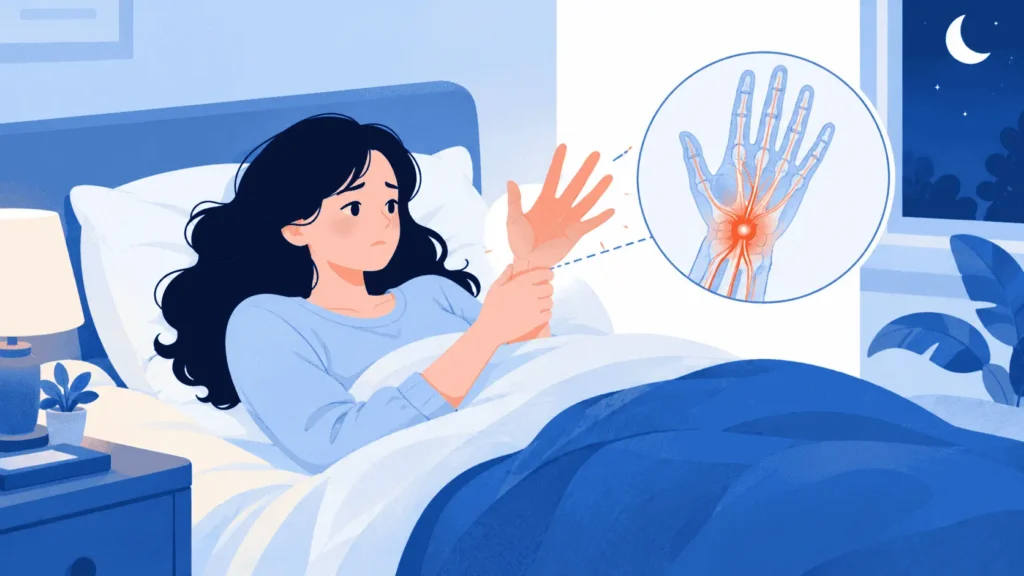
Have you ever woken up in the middle of the night with your hand feeling numb or your fingers tingling? You might shake your hand, stretch your arm, or change your sleeping position, and within a few minutes, the feeling disappears.
But when it happens repeatedly, you may start wondering whether something is wrong.
So, why do my hands go numb when I sleep?
In many cases, nighttime hand numbness happens because your sleeping position puts pressure on a nerve in your arm, elbow, or wrist. However, recurring numbness can also be associated with conditions such as carpal tunnel syndrome, a pinched nerve in your neck, or peripheral neuropathy.
Understanding what causes your hands to go numb at night can help you recognize when simple changes may be enough and when it is important to seek medical advice.
What Causes Numbness in Hands While Sleeping?
Your hands contain nerves that carry signals between your brain, spinal cord, and fingers. These signals allow you to feel touch, pressure, temperature, and pain.
When a nerve becomes compressed or irritated, these signals may be disrupted, causing numbness, tingling, or a pins-and-needles sensation.
For example, sleeping with your arm underneath your head or keeping your wrist bent for several hours can put pressure on nearby nerves. Once you change positions, the pressure may ease and normal sensation can gradually return.
This type of temporary numbness is usually harmless.
However, numbness in hands while sleeping is not always caused by an uncomfortable sleeping position. Sometimes, it may indicate an underlying nerve or medical condition that requires evaluation.
7 Common Reasons Your Hands Go Numb at Night
There are several possible reasons you may wake up with numb hands. Some involve temporary pressure on nerves, while others are related to conditions affecting the nervous system.

Here are seven causes worth understanding.
1. Sleeping Position and Nerve Compression
One of the most common reasons your hands go numb during sleep is pressure on a nerve.
You may be sleeping with your arm underneath your pillow, your wrist bent toward your body, or your elbow folded tightly for an extended period.
These positions can compress nerves and temporarily affect sensation in your hands and fingers.
You may notice:
- Tingling or pins and needles in your fingers
- A temporary loss of sensation in your hand
- Numbness that improves after changing positions
- An arm that feels as though it has fallen asleep
If your symptoms disappear shortly after moving your arm, temporary nerve compression may be the cause.
However, if the numbness keeps returning, it is worth considering other possible explanations.
2. Carpal Tunnel Syndrome
If you frequently wake up with numbness in your thumb, index finger, or middle finger, carpal tunnel syndrome may be responsible.
Carpal tunnel syndrome occurs when the median nerve becomes compressed as it passes through a narrow passage in your wrist.
Symptoms often become more noticeable at night, particularly when your wrist remains bent during sleep.
Common symptoms include:
- Tingling or numbness in the thumb, index, and middle fingers
- Hand discomfort that interrupts sleep
- Weakness when gripping objects
- Difficulty holding small items
- Symptoms that improve temporarily after shaking your hand
Carpal tunnel syndrome can gradually worsen if nerve compression continues.
Early evaluation can help determine whether wrist splinting, activity changes, or other treatment options may be appropriate.
3. A Pinched Nerve in Your Neck
Sometimes, the reason your hands go numb while sleeping is not in your hands at all.
It may begin in your neck.
Your cervical spine contains nerve roots that travel through your shoulders and arms toward your hands.
When one of these nerve roots becomes irritated or compressed, it can cause a condition called cervical radiculopathy.
This may happen because of a herniated disc, age-related changes in the spine, or narrowing around a nerve.
Possible symptoms include:
- Neck pain or stiffness
- Tingling that travels down your arm
- Numbness in certain fingers
- Shoulder or arm discomfort
- Weakness in the affected arm or hand
Not everyone with cervical radiculopathy experiences neck pain. In some cases, symptoms are more noticeable in the arm or hand.
If your nighttime numbness occurs alongside neck or shoulder discomfort, a healthcare professional can evaluate whether a cervical nerve problem may be contributing.
4. Peripheral Neuropathy
Peripheral neuropathy develops when nerves outside the brain and spinal cord become damaged or do not function normally.
Unlike temporary nerve compression caused by sleeping posture, peripheral neuropathy may cause symptoms that continue throughout the day or become more noticeable at night.
Common symptoms include:
- Burning or tingling sensations
- Numbness in the fingertips
- Reduced sensitivity to touch
- Sharp or shooting nerve pain
- Weakness or balance difficulties in some cases
Peripheral neuropathy can have several causes, including diabetes, certain vitamin deficiencies, medications, and other medical conditions.
It often begins in the feet before affecting the hands, although the pattern depends on the underlying cause.
If you are experiencing ongoing numbness, understanding the cause is important because treatment depends on which nerves are affected and why. Read more about neuropathy here.
5. Cubital Tunnel Syndrome
Have you ever woken up with your ring finger and little finger feeling numb?
This may be related to the ulnar nerve, which travels along the inside of your elbow.
Cubital tunnel syndrome occurs when this nerve becomes compressed or irritated near the elbow.
Keeping your elbows bent for long periods, especially during sleep, can increase pressure on the nerve.
Symptoms may include:
- Numbness in the ring and little fingers
- Tingling along the inner side of the hand
- Discomfort around the elbow
- Hand weakness in more advanced cases
Avoiding prolonged elbow bending may help reduce symptoms.
However, persistent numbness or weakness should be evaluated to prevent further nerve problems.
6. Vitamin B12 Deficiency
Vitamin B12 plays an important role in maintaining healthy nerves.
When your body does not have enough vitamin B12, nerve function can become affected, potentially causing numbness or tingling in your hands and feet.
Other possible symptoms include fatigue, weakness, difficulty maintaining balance, and problems with concentration.
Unlike temporary numbness caused by sleeping posture, symptoms related to vitamin B12 deficiency may occur at different times throughout the day.
A healthcare professional may recommend blood testing if your symptoms or medical history suggest a deficiency.
Identifying and treating a deficiency early is important because prolonged nerve damage may not always be fully reversible.
7. Diabetes and Other Underlying Health Conditions
Sometimes, recurring hand numbness is related to a broader medical condition rather than pressure on a particular nerve.
Diabetes is one example.
Over time, elevated blood sugar can damage peripheral nerves, leading to diabetic neuropathy. Although symptoms commonly begin in the feet, the hands may also become affected.
Other conditions that may contribute to numbness include thyroid disorders, inflammatory diseases, and certain autoimmune conditions.
These problems can affect nerve health in different ways.
If numbness affects both hands, continues during the day, or occurs alongside other unexplained symptoms, a medical evaluation may help identify an underlying cause.
What Does It Mean When Different Fingers Go Numb?
One of the most useful things to notice is which fingers become numb.
Different nerves supply sensation to different areas of your hand. The pattern of numbness can sometimes help healthcare professionals identify where a nerve may be irritated.
| Where you feel numbness | Possible explanation |
| Thumb, index, and middle fingers | Carpal tunnel syndrome |
| Ring and little fingers | Ulnar nerve compression |
| Fingers with neck or radiating arm pain | Possible cervical nerve irritation |
| Both hands with persistent tingling | Peripheral neuropathy or another medical condition |
| Hand or arm after sleeping on it | Temporary nerve compression |
These patterns are general clues, not a diagnosis. Nerve symptoms can overlap, and more than one condition may be present.
Try paying attention to which fingers are affected, how long the numbness lasts, and whether changing your sleeping position helps.
Sharing these details with your healthcare professional may make it easier to investigate the cause.
How Can You Stop Your Hands From Going Numb While Sleeping?
If your nighttime numbness is caused by temporary nerve pressure, a few changes to your sleeping habits may help.
Keep Your Wrists in a Neutral Position
Avoid sleeping with your wrists sharply bent underneath your head or pillow.
Keeping your wrists relatively straight can help reduce pressure on the median nerve.
For people with carpal tunnel syndrome, a properly fitted nighttime wrist splint may also help reduce symptoms.
Avoid Sleeping Directly on Your Arms
Sleeping with your arm trapped underneath your body can compress nerves and lead to temporary numbness.
Try resting your arms comfortably beside your body or using a pillow for support.
Avoid Keeping Your Elbows Tightly Bent
If your ring and little fingers become numb, sleeping with your elbows bent for long periods may be contributing.
Keeping your elbows in a more relaxed position may help reduce pressure on the ulnar nerve.
Support Your Neck Comfortably
Choose a pillow that supports your head and neck without forcing your neck into an uncomfortable position.
Although changing pillows will not treat every cause of hand numbness, comfortable neck positioning may reduce unnecessary strain.
Take Breaks From Repetitive Activities
Activities involving repeated wrist movements, prolonged gripping, or sustained elbow bending can aggravate certain nerve compression conditions.
Taking regular breaks and adjusting your workstation or daily habits may help reduce irritation.
Remember: These changes are most likely to help when symptoms are related to positioning or nerve compression. If your numbness continues, do not rely on sleeping adjustments alone.
When Should You Be Concerned About Hand Numbness?
Occasional numbness that disappears after changing your sleeping position is not always a cause for concern.
However, recurring or persistent symptoms should not be ignored.
Schedule a healthcare evaluation if:
- Your hands become numb several nights a week
- Numbness continues after waking up
- You experience weakness or frequently drop objects
- Symptoms gradually become more frequent or severe
- Tingling or numbness begins affecting everyday activities
- You experience numbness in both your hands and feet
When is hand numbness an emergency?
Seek emergency medical attention if numbness develops suddenly, particularly when it affects one side of the body or occurs with facial drooping, difficulty speaking, sudden weakness, vision changes, or loss of balance.
These may be warning signs of a stroke or another serious neurological problem.
Early evaluation is especially important when symptoms are new, severe, or worsening.
How Is the Cause of Hand Numbness Diagnosed?
Because several different conditions can cause nighttime hand numbness, identifying the underlying problem is an important step before choosing treatment.
A healthcare professional may begin by asking about your symptoms, sleeping habits, medical history, and daily activities.
They may also examine your neck, arms, wrists, and hands to assess sensation, muscle strength, and nerve function.
Depending on your symptoms, further testing may include:
- Nerve conduction studies: To evaluate how electrical signals travel through peripheral nerves.
- Electromyography (EMG): To assess electrical activity in muscles and help identify certain nerve or muscle problems.
- Blood tests: To check for conditions such as diabetes, vitamin B12 deficiency, or thyroid problems.
- Imaging tests: MRI or other imaging may be considered when symptoms suggest certain spinal or structural problems.
Not everyone with nighttime numbness needs these tests.
The appropriate evaluation depends on your symptoms, examination findings, and medical history.
What Treatments Can Help With Hand Numbness?
Treatment for hand numbness depends on what is causing it. In some cases, simple changes to your sleeping position or daily habits may be enough to reduce symptoms. However, recurring numbness may require professional evaluation and targeted treatment.
For nerve compression conditions such as carpal tunnel syndrome, nighttime wrist splints, activity modifications, or physical therapy may help. If the numbness is related to a pinched nerve in your neck, treatment may involve exercises, physical therapy, or other appropriate conservative care.
For people with neck-related musculoskeletal problems, chiropractic care may be considered following a proper assessment. However, not all causes of hand numbness can be treated through chiropractic adjustments.
When numbness is caused by peripheral neuropathy or conditions such as diabetes or vitamin B12 deficiency, treatment focuses on managing the underlying health problem.
The most important step is identifying the cause of your numbness so you can receive the right care.
Looking for Help With Hand Numbness or Neuropathy in Sanford, Florida?
Waking up with numb hands can be uncomfortable, especially when it begins interrupting your sleep or affecting your everyday activities.
At VitalSpine Chiropractic in Sanford, Florida, Dr. Michaelene Callahan, DC, takes a personalized approach to chiropractic care, focusing on spinal health, musculoskeletal function, and understanding each patient’s concerns.
With more than 20 years of chiropractic experience, Dr. Callahan works with patients seeking guidance for spinal and musculoskeletal problems.
If you are experiencing hand numbness alongside neck discomfort or suspect that a spinal problem may be contributing to your symptoms, the team can discuss whether a chiropractic assessment is appropriate.
Because hand numbness can have many causes, some patients may need medical testing or evaluation by another healthcare professional before deciding on treatment.
Recurring hand numbness deserves attention, especially when it begins affecting your sleep or daily activities.
Contact VitalSpine Chiropractic to schedule an appointment and discuss your concerns.
Frequently Asked Questions
Why do my hands go numb every night but feel normal during the day?
Nighttime hand numbness often occurs when sleeping positions put pressure on nerves in your wrists, elbows, or arms. Carpal tunnel syndrome is another possible cause because symptoms frequently become more noticeable at night. If it happens regularly, consider a professional evaluation.
Can sleeping on your side cause your hands to go numb?
Yes. Sleeping on your side with your arm underneath your body or pillow can compress nerves and temporarily affect sensation. Changing your arm position may help, although persistent symptoms should be assessed.
Why do the tips of my fingers feel numb?
Numb fingertips may be associated with nerve compression, carpal tunnel syndrome, peripheral neuropathy, or certain medical conditions. The specific fingers affected and any accompanying symptoms can help guide an evaluation.
Can a pinched nerve in your neck cause numbness in both hands?
Some cervical spine conditions can cause symptoms in both hands. However, numbness affecting both hands can also result from peripheral nerve compression or systemic medical conditions. Bilateral symptoms should not automatically be attributed to the neck.
Can hand numbness go away on its own?
Temporary numbness caused by sleeping on your arm often improves once pressure on the nerve is relieved. However, numbness caused by ongoing nerve compression or an underlying medical condition may require treatment.
Medical References
The following resources provide additional information about conditions discussed in this article:
- MedlinePlus — Carpal Tunnel Syndrome
- MedlinePlus — Peripheral Neuropathy
- NIH Office of Dietary Supplements — Vitamin B12
- AAOS OrthoInfo — Cervical Radiculopathy
- CDC — Signs and Symptoms of Stroke
Medical disclaimer: This article is intended for general educational purposes and does not replace professional medical advice, diagnosis, or treatment. Seek advice from a qualified healthcare professional about persistent, worsening, or unexplained symptoms.