
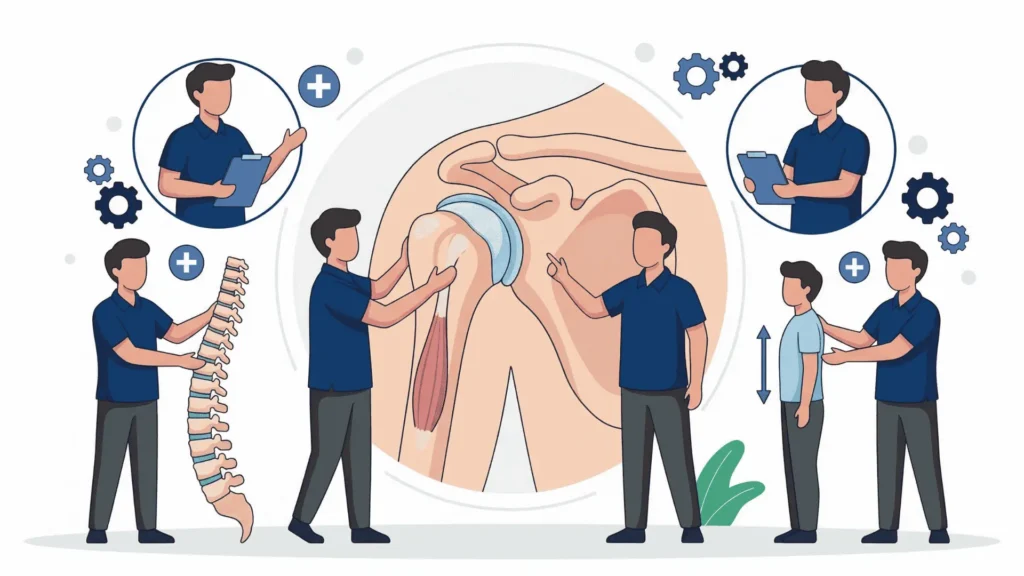
Shoulder pain can make even simple things difficult. Reaching for something on a shelf, getting dressed, or sleeping comfortably may suddenly become a challenge.
Sometimes the pain starts after an injury. Other times, it develops gradually, and you are not sure what caused it.
That leads to an important question: What doctor should you see for shoulder pain?
For most non-emergency shoulder problems, a primary care doctor is a good starting point. Depending on your symptoms, you may also benefit from an orthopedic specialist, sports medicine physician, physical therapist, or another qualified healthcare professional.
The right choice depends on where the pain comes from, how severe it is, and whether you have other symptoms.
Here’s how to decide where to start.
What Kind of Doctor Treats Shoulder Pain?
Several healthcare professionals assess and treat shoulder pain, but they have different roles.
| Healthcare professional | When they may be appropriate |
| Primary care doctor | New, persistent, or unexplained shoulder pain |
| Orthopedic specialist | Suspected tendon tears, joint injuries, fractures, or significant arthritis |
| Sports medicine physician | Sports injuries, overuse problems, and activity-related shoulder pain |
| Physical therapist | Rehabilitation, movement limitations, weakness, and recovery |
| Chiropractor | Selected musculoskeletal complaints involving the shoulder, neck, or upper back |
| Neurologist | Unexplained neurological symptoms, progressive weakness, or suspected nerve disorders |
You do not always need to see a specialist first.
A primary care clinician can often evaluate the problem and recommend the next step.
1. Primary Care Doctor: A Good Starting Point
If your shoulder pain is new, persistent, or difficult to explain, a primary care doctor is often the most practical first choice.
They can review your symptoms, examine your shoulder, and consider whether the pain originates in the joint, surrounding muscles, neck, or another part of the body.
Your doctor may:
- Check shoulder movement and strength
- Ask about injuries or repetitive activities
- Assess for nerve-related symptoms
- Recommend appropriate pain management
- Arrange imaging when necessary
- Refer you to a specialist
For many common shoulder conditions, treatment begins without surgery.
However, symptoms suggesting a serious injury or medical emergency require more urgent care.
2. Orthopedic Doctor: For Joint and Structural Problems
An orthopedic specialist focuses on conditions affecting bones, joints, muscles, tendons, and ligaments.
You may be referred to an orthopedic doctor if you have:
- A suspected rotator cuff tear
- A significant shoulder injury
- Recurrent shoulder dislocations
- Severe or persistent joint pain
- Advanced shoulder arthritis
- Symptoms that have not improved with appropriate conservative treatment
Orthopedic specialists can recommend non-surgical treatment as well as surgery when necessary.
Seeing an orthopedic surgeon does not automatically mean you need an operation.
Many shoulder conditions are initially managed with rehabilitation, medication, or other conservative approaches.
3. Sports Medicine Doctor: For Injuries and Overuse
Sports medicine physicians assess musculoskeletal injuries and activity-related pain.
You do not have to be a professional athlete to see one.
They may help with:
- Shoulder pain from lifting weights
- Throwing-related injuries
- Repetitive overhead movements
- Tendon irritation
- Certain muscle strains
- Returning safely to exercise
A sports medicine doctor can help identify the condition and recommend an appropriate recovery plan.
4. Physical Therapist: For Shoulder Strength and Movement
Physical therapists focus on improving movement, strength, and physical function.
Physical therapy is commonly used for shoulder conditions such as:
- Rotator cuff-related pain
- Frozen shoulder
- Shoulder stiffness
- Certain tendon problems
- Rehabilitation after injury or surgery
Treatment may include strengthening exercises, mobility work, activity modifications, and gradual return to normal movement.
In Florida, physical therapists may be accessed directly in certain circumstances, although referral and insurance requirements can vary.
5. Chiropractor: For Selected Musculoskeletal Shoulder Problems
Some shoulder discomfort is associated with problems involving the surrounding muscles, joints, neck, or upper back.
A chiropractor may assess musculoskeletal factors that could be contributing to these symptoms.
Depending on the diagnosis, conservative care may include:
- Movement and mobility assessment
- Exercise recommendations
- Advice about daily activities
- Selected manual therapies
- Guidance on ergonomics
However, chiropractic adjustments are not a proven treatment for every shoulder condition.
For example, a significant rotator cuff tear, fracture, infection, or serious neurological problem may require medical or specialist treatment.
A responsible approach involves identifying when chiropractic care may be appropriate and when referral is necessary.
Learn more about chiropractic care and the clinic’s shoulder pain services.
6. Neurologist: When Nerve Symptoms Need Investigation
Sometimes shoulder pain is accompanied by numbness, tingling, or weakness.
These symptoms may be related to a nerve problem rather than the shoulder joint itself.
For example, irritation of a nerve root in the neck can sometimes cause pain travelling toward the shoulder or arm.
A neurologist may be appropriate when symptoms suggest a neurological disorder or when the diagnosis remains unclear.
A primary care doctor can help determine whether neurological referral is necessary.
What Causes Shoulder Pain?
Understanding the possible cause can help you choose the right healthcare professional.
Rotator Cuff Injuries
The rotator cuff is a group of muscles and tendons that help stabilise and move the shoulder.
Injury or irritation may cause pain when lifting your arm, reaching overhead, or lying on the affected side.
Frozen Shoulder
Frozen shoulder, also called adhesive capsulitis, causes pain and progressive stiffness.
People may struggle to move their arm normally, even with assistance.
Shoulder Arthritis
Arthritis can cause joint pain, stiffness, and reduced movement.
Symptoms may develop gradually and become more noticeable during certain activities.
Read more about osteoarthritis.
Muscle Strain or Overuse
Repetitive movements, heavy lifting, or unfamiliar exercise may irritate muscles and tendons around the shoulder.
Mild strains often improve with appropriate activity adjustments and time.
Neck-Related Nerve Irritation
Some shoulder pain originates in the cervical spine.
If a nerve root becomes irritated, pain may travel into the shoulder, arm, or hand.
You might also notice tingling, numbness, or weakness.
Learn more about neck pain.
Shoulder Dislocation or Fracture
A fall, collision, or other injury can damage the bones or joints around the shoulder.
These injuries require prompt medical assessment.
Which Doctor Should You See Based on Your Symptoms?
Different symptoms may point toward different care pathways.
| Your symptoms | Suggested next step |
| Mild pain after overuse | Primary care or appropriate conservative assessment if it persists |
| Shoulder pain with stiffness | Primary care, physical therapy, or orthopedic assessment |
| Pain after a fall or injury | Prompt medical evaluation; urgent care or emergency department if severe |
| Suspected rotator cuff tear | Primary care, sports medicine, or orthopedics |
| Pain with neck symptoms or tingling | Medical evaluation to assess possible nerve involvement |
| Persistent pain despite treatment | Reassessment and possible specialist referral |
| Shoulder pain with chest pressure or breathlessness | Emergency medical care |
These are general pathways rather than a diagnosis.
The most appropriate provider depends on the full clinical picture.
When Should You See a Doctor for Shoulder Pain?
Arrange a medical appointment if you experience:
- Pain lasting more than a few days without improvement
- Pain that repeatedly returns
- Difficulty lifting or moving your arm
- Shoulder stiffness affecting daily activities
- Pain that regularly interrupts sleep
- Persistent numbness or tingling
- Increasing weakness
You should also seek assessment if the pain began after an injury, particularly when there is swelling, bruising, or reduced movement.
When Is Shoulder Pain an Emergency?
Seek emergency medical attention if shoulder pain occurs with:
- Chest pain or pressure
- Shortness of breath
- Sweating, nausea, or fainting
- Sudden severe pain after an injury
- An obvious deformity
- A cold, pale, or poorly perfused arm
- Sudden weakness or other stroke-like symptoms
Shoulder pain can occasionally be referred from the heart or another serious medical condition.
Do not assume every case is caused by a muscle or joint problem.
Do You Need an X-Ray or MRI for Shoulder Pain?
Not everyone with shoulder pain needs imaging.
A healthcare professional will usually begin with a history and physical examination.
Depending on the suspected condition, they may recommend:
- X-ray: Often used to assess fractures, dislocations, or certain arthritic changes.
- Ultrasound: May help evaluate rotator cuff tendons and other soft tissues.
- MRI: May be considered for suspected significant soft-tissue injuries or when symptoms and examination findings justify further investigation.
Imaging should be selected based on the clinical situation rather than ordered automatically for every patient.
Can Shoulder Pain Improve Without Surgery?
Yes. Many common shoulder problems improve with conservative treatment.
Depending on the diagnosis, treatment may include:
- Activity modification
- Physical therapy
- Strengthening and mobility exercises
- Appropriate pain medication
- Other clinician-recommended interventions
However, some injuries and medical conditions require specialist treatment or surgery.
The goal is to choose the treatment most appropriate for the actual problem.
What Can You Do for Mild Shoulder Pain at Home?
If your symptoms are mild, there has been no significant injury, and you have no warning signs, you may find these measures helpful.
Keep the Shoulder Moving Comfortably
Gentle movement can help prevent unnecessary stiffness.
Avoid forcing the shoulder through painful movements.
Reduce Aggravating Activities Temporarily
If overhead lifting or repetitive reaching increases discomfort, consider reducing those activities until symptoms improve.
Try Heat or Cold
A cold pack may help after a recent minor strain.
Heat may feel more comfortable for muscle tightness or stiffness.
Protect your skin and avoid extreme temperatures.
Avoid Sleeping Directly on the Painful Shoulder
Changing your sleeping position or supporting the arm with a pillow may improve comfort.
Return Gradually to Normal Activities
As pain settles, gradually resume usual movements and activities.
If symptoms worsen or do not improve, seek professional assessment.
Questions to Ask Your Shoulder Pain Specialist
Before beginning treatment, consider asking:
- What is the most likely cause of my shoulder pain?
- Do I need imaging or further testing?
- Which treatments are recommended for my condition?
- Would physical therapy be helpful?
- Are there activities I should temporarily avoid?
- What symptoms would mean I need further medical attention?
- How long might recovery take?
Understanding the diagnosis and expected recovery can help you make informed decisions.
Shoulder Pain Care in Sanford, FL
If you’re experiencing shoulder discomfort, finding out what is causing it is the first step toward choosing appropriate treatment.
At VitalSpine Chiropractic in Sanford, FL, Dr. Michaelene Callahan, DC, offers chiropractic and musculoskeletal care.
For selected musculoskeletal shoulder complaints, the clinic may be able to discuss conservative treatment options or recommend further medical evaluation when appropriate.
Explore VitalSpine’s shoulder pain service to learn more.
To discuss available services, contact VitalSpine Chiropractic.
Frequently Asked Questions
1. Should I see a chiropractor or orthopedic doctor for shoulder pain?
It depends on the cause. An orthopedic specialist is appropriate for suspected significant structural injuries, while a chiropractor may assess selected musculoskeletal complaints. Primary care is often a good starting point when the diagnosis is unclear.
2. Can shoulder pain come from the neck instead of the shoulder?
Yes. Cervical nerve root irritation and some other neck conditions can cause pain around the shoulder or down the arm. Associated numbness, tingling, or weakness should be assessed.
3. What doctor should I see for shoulder pain when lifting my arm?
A primary care or sports medicine clinician can evaluate pain associated with lifting your arm. Depending on the findings, physical therapy or orthopedic referral may be appropriate.
4. Do I need a referral to see a shoulder specialist?
Referral requirements depend on the specialist, healthcare system, and insurance plan. Contact the provider and your insurer to confirm.
5. How long should I wait before getting shoulder pain checked?
Mild pain after overuse may improve with self-care over several days. Seek assessment sooner if pain is severe, follows an injury, causes weakness, or significantly limits movement. Persistent or worsening pain should not be ignored.
Disclaimer
This article is for educational purposes only and does not replace professional medical advice, diagnosis, or treatment. Shoulder pain can have many causes, and the appropriate healthcare professional or treatment depends on individual symptoms and examination findings.