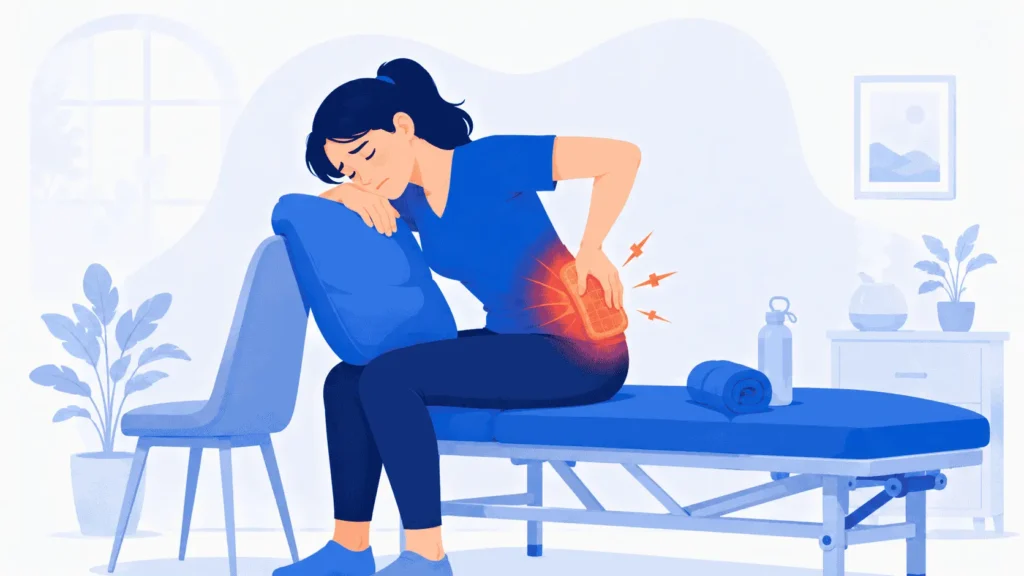
One moment, you’re moving normally. The next, a sharp pain catches your back when you bend, stand up, or lift something.
Suddenly, even simple movements feel difficult.
Sudden severe back pain can be frightening, especially when you cannot identify exactly what caused it. Sometimes, it develops after physical strain. Other times, it seems to appear without warning.
Many episodes of acute back pain improve with time and appropriate care. However, severe pain can occasionally indicate a condition that needs urgent medical attention.
If your back pain has started suddenly, here are nine practical tips to help you manage discomfort safely, along with signs that mean you should seek medical help.
What Should You Do First When Severe Back Pain Starts?
Before trying stretches, massage, or other treatments, consider how the pain started and whether you have any warning signs.
Seek emergency medical care if sudden back pain occurs with:
- New loss of bladder or bowel control
- Difficulty urinating together with new neurological symptoms
- Numbness around the groin or inner thighs
- Rapidly worsening weakness in one or both legs
- Severe pain following a major accident or fall
Sudden severe back or chest pain accompanied by fainting, breathing difficulty, or chest discomfort also requires emergency evaluation.
If none of these symptoms are present, but your pain is severe, new, or makes walking or standing difficult, seek prompt medical advice rather than assuming it is a simple muscle strain.
9 Tips to Manage Sudden Severe Back Pain
These suggestions are intended for uncomplicated musculoskeletal back pain after serious causes have been ruled out.
1. Keep Moving Gently, Without Forcing Yourself
When your back suddenly hurts, your first instinct may be to lie down and avoid moving.
A short period of comfortable rest may be reasonable, but staying in bed for several days can contribute to stiffness and reduced physical conditioning.
If you can move safely, try:
- Walking short distances around your home
- Changing positions regularly
- Continuing light daily activities within your comfort level
- Taking breaks when symptoms increase
You do not need to push through intense pain.
Remember: The goal is comfortable movement, not forcing yourself to complete your usual routine immediately.
2. Try Heat or Cold Therapy
A warm compress or wrapped cold pack may temporarily reduce discomfort.
Some people prefer warmth for muscle tightness, while others find cold more comfortable after an injury.
You can try:
- Applying a wrapped cold pack for approximately 10–20 minutes
- Using a warm compress or heating pad at a comfortable temperature
- Allowing your skin to return to its normal temperature between applications
- Choosing whichever option provides greater comfort
There is no universal rule that everyone must use ice for the first 48 hours and heat afterward.
Safety tip: Never place ice directly against bare skin or sleep with an electric heating pad switched on.
3. Find a Comfortable Position
When sudden back pain develops, certain positions may feel much worse than others.
Instead of trying to maintain a supposedly perfect posture, find a position that reduces discomfort.
You might try:
- Sitting in a supportive chair for short periods
- Lying on your side with a pillow between your knees
- Lying on your back with a pillow beneath your knees
- Standing or walking briefly if sitting aggravates symptoms
Avoid staying in one position for too long if changing position feels comfortable.
The best position is usually one that allows you to relax without worsening symptoms.
4. Avoid Heavy Lifting and Painful Twisting
Heavy lifting or sudden twisting may aggravate an already painful back.
During an acute episode, temporarily reduce activities that clearly worsen your symptoms.
For example:
- Ask for help with heavy objects.
- Divide large loads into smaller ones.
- Keep objects close to your body when lifting.
- Turn your whole body instead of twisting sharply under load.
- Resume demanding activities gradually as symptoms improve.
You do not need to avoid bending or lifting forever.
The aim is to manage painful activities temporarily while rebuilding your normal movement tolerance.
5. Be Careful With Stretching
Stretching may seem like the quickest way to loosen a painful back.
However, during an episode of sudden severe pain, aggressive stretching can make some conditions worse.
Avoid forcing movements such as deep forward bends, strong spinal twists, or prolonged stretches that increase discomfort.
If your pain is settling and gentle movement feels comfortable, you may gradually introduce suitable mobility exercises.
For examples of lower back movements, see our guide to 10 stretches for lower back pain relief.
Important: Stop any stretch that causes sharp pain, increasing numbness, weakness, or pain spreading farther down your leg.
6. Make Sleep More Comfortable
Back pain can make falling asleep or changing positions difficult.
There is no single sleeping position that works best for everyone.
However, small adjustments may help.
If you sleep on your side, try placing a pillow between your knees.
If you prefer sleeping on your back, a pillow beneath your knees may reduce discomfort.
Choose a mattress and pillow arrangement that feels supportive rather than trying to force your body into an uncomfortable position.
If pain is severe at night, does not improve with changing position, or is accompanied by fever or other concerning symptoms, arrange medical evaluation.
7. Consider Appropriate Pain Relief
Some over-the-counter medicines may help manage acute back pain, but they are not suitable for everyone.
For example, nonsteroidal anti-inflammatory drugs (NSAIDs) can carry risks for people with certain kidney, stomach, heart, or pregnancy-related conditions.
Before taking medication, check with a pharmacist or qualified healthcare professional, especially if you have existing medical conditions or take other medicines.
Avoid exceeding recommended doses or combining medicines without professional advice.
Pain relief may make movement more comfortable, but it does not replace evaluation when symptoms suggest a serious condition.
8. Know When to Seek Professional Evaluation
Not every episode of back pain requires immediate treatment, but sudden severe pain should not automatically be managed at home.
Arrange prompt medical evaluation if:
- The pain is unusually intense or worsening
- You cannot walk or stand normally because of the pain
- Symptoms follow an injury
- Pain travels into your leg with numbness or weakness
- You develop fever or feel generally unwell
- Symptoms are not improving as expected
A healthcare professional can assess possible causes and determine whether examination, imaging, medication, or another treatment is needed.
Once serious conditions have been excluded, conservative treatment may be appropriate for certain musculoskeletal problems.
For more information about conservative approaches, read our article on back pain treatment without surgery.
9. Return to Normal Activities Gradually
As your pain begins to settle, gradually returning to ordinary activities can support recovery.
Start with movements that feel manageable.
You might:
- Increase walking time gradually
- Resume light household activities
- Take regular breaks from prolonged sitting
- Introduce gentle strengthening exercises when appropriate
- Build back toward your usual exercise routine
Recovery is not always perfectly smooth.
Some days may feel better than others, and mild temporary soreness does not necessarily mean you have injured your back again.
However, worsening pain or new neurological symptoms should prompt reassessment.
What Causes Sudden Severe Lower Back Pain?
Sudden pain can develop for several reasons.
Common musculoskeletal causes include:
Muscle or ligament strain: A sudden movement, heavy lift, or unfamiliar activity may irritate muscles and surrounding tissues.
Disc-related problems: Changes in a spinal disc can sometimes cause back pain, particularly when nearby nerves become irritated.
Joint irritation: Spinal joints may become painful during certain movements or activities.
Sciatica: Irritation of a nerve in the lower spine can cause pain that travels into the buttock or leg.
However, not every case of sudden severe back pain comes from the spine itself.
Kidney conditions, fractures, infections, and other medical problems can also cause back pain.
Pain intensity alone cannot reliably identify the cause.
How Long Does Sudden Back Pain Usually Last?
Acute back pain often improves over days to weeks, although recovery varies.
Some people feel noticeably better after a few days. Others need several weeks before normal activities become comfortable again.
Recovery depends on factors such as the underlying condition, previous back pain episodes, physical activity, and general health.
If symptoms continue, worsen, or significantly interfere with daily activities, seek an assessment rather than repeatedly trying new home remedies.
When Is Sudden Back Pain an Emergency?
Knowing the difference between uncomfortable symptoms and medical warning signs is important.
| Symptom | What to do |
| Mild to moderate back pain after activity, gradually improving | Gentle self-care may be reasonable |
| New severe pain that significantly limits movement | Seek prompt medical assessment |
| Pain with persistent tingling or numbness | Arrange timely medical evaluation |
| Back pain with fever or following significant trauma | Seek urgent medical care |
| New bladder or bowel dysfunction, saddle numbness, or rapidly worsening leg weakness | Seek emergency care immediately |
| Sudden severe back pain with chest pain, fainting, or breathing difficulty | Seek emergency care immediately |
Do not attempt to stretch, massage, or manipulate your back when symptoms suggest a medical emergency.
Can Sudden Severe Back Pain Improve Without Surgery?
Yes. Many cases of acute back pain improve without surgery.
Depending on the diagnosis, treatment may involve activity guidance, medication, exercise-based rehabilitation, or other conservative approaches.
Surgery is generally considered for selected conditions rather than ordinary episodes of acute mechanical back pain.
If symptoms suggest significant nerve compression or another serious condition, specialist assessment may be necessary.
Getting Help for Back Pain in Sanford, FL
If sudden back pain has been medically assessed and your symptoms are suitable for conservative musculoskeletal care, chiropractic treatment may be one option to discuss.
At VitalSpine Chiropractic in Sanford, FL, Dr. Michaelene Callahan, DC, provides chiropractic assessments and care for appropriate musculoskeletal conditions.

An assessment may include discussing your symptoms, reviewing your medical history, and evaluating movement and function.
If your symptoms suggest a condition requiring medical investigation, referral to an appropriate healthcare professional may be necessary.
To learn more about the clinic’s services, visit our back pain care page.
You can also book an appointment or contact us if a chiropractic consultation is appropriate for your symptoms.
Frequently Asked Questions
1. Can sudden severe back pain happen without an injury?
Yes. Sudden back pain can occur during ordinary activities or without a clear triggering event. However, severe unexplained pain should be medically evaluated, particularly when accompanied by other symptoms.
2. Should I walk when my lower back suddenly hurts?
Gentle walking may help some people with uncomplicated back pain, provided they can move safely and symptoms do not worsen. Do not force yourself to walk if pain is severe, movement is unsafe, or neurological symptoms are present.
3. Is it better to sit or lie down with sudden lower back pain?
Neither position is universally better. Choose whichever position feels comfortable, and change positions periodically if you can do so safely. Avoid prolonged bed rest when possible.
4. Can sudden back pain be caused by a herniated disc?
Yes. A herniated disc can sometimes cause sudden back pain, particularly when it irritates a spinal nerve. However, symptoms alone cannot confirm a disc problem, and many other conditions can produce similar pain.
5. Should I use a back brace for sudden lower back pain?
A brace may be recommended in certain circumstances, but routine use is not necessary for most uncomplicated episodes of acute back pain. Ask a qualified healthcare professional whether a brace is appropriate for your condition.
Disclaimer
This article provides general educational information and does not replace professional medical advice, diagnosis, or treatment. Sudden severe back pain can occasionally indicate a serious medical condition. Seek prompt or emergency medical care when warning signs are present.evere back pain or related conditions.