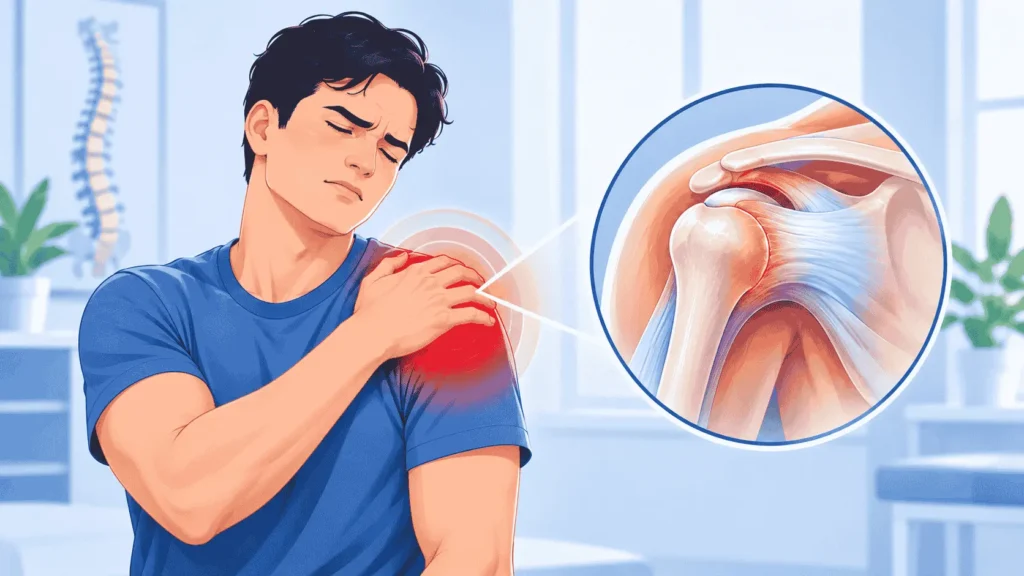
Imagine reaching into the back seat of your car and feeling a sharp pain in your shoulder. A few days later, putting on a jacket feels uncomfortable. Eventually, even reaching for something on a high shelf becomes difficult.
At first, you might think you’ve slept in an awkward position or pulled a muscle. But as the stiffness gets worse, you start wondering why your shoulder isn’t moving the way it used to.
Frozen shoulder, also called adhesive capsulitis, is a condition that causes pain and increasing stiffness in the shoulder joint. It develops when the tissue surrounding the joint becomes inflamed and tight, making everyday movements harder.
The condition often develops gradually and can take months, sometimes years, to improve.
At VitalSpine Chiropractic in Sanford, FL, we understand how frustrating shoulder discomfort can be when it starts interfering with your daily routine. Knowing what frozen shoulder feels like, how it progresses, and which treatments may help can make it easier to take the next step.
What Does Frozen Shoulder Feel Like?
Frozen shoulder doesn’t always begin with severe pain.
You might first notice a dull ache around your shoulder, particularly when reaching overhead or behind your back.
Over time, the pain may become more noticeable, and your shoulder may start feeling increasingly stiff.
Common symptoms include:
- Aching shoulder pain: Discomfort that may spread into the upper arm.
- Difficulty reaching overhead: Everyday tasks like putting dishes away can become frustrating.
- Pain when reaching behind your back: Fastening a bra, tucking in a shirt, or reaching for a wallet may become difficult.
- Shoulder stiffness: Your arm may not move as freely as it used to.
- Nighttime discomfort: Sleeping on the affected shoulder may become painful.
One important clue is that frozen shoulder restricts both active and passive movement. That means you may struggle to lift your arm yourself, and another person may also find it difficult to move your relaxed arm through its normal range.
This helps healthcare professionals distinguish frozen shoulder from some other shoulder conditions.
What Are the Three Stages of Frozen Shoulder?
Frozen shoulder usually develops gradually. Healthcare professionals often describe three stages, although not everyone experiences them in exactly the same way.
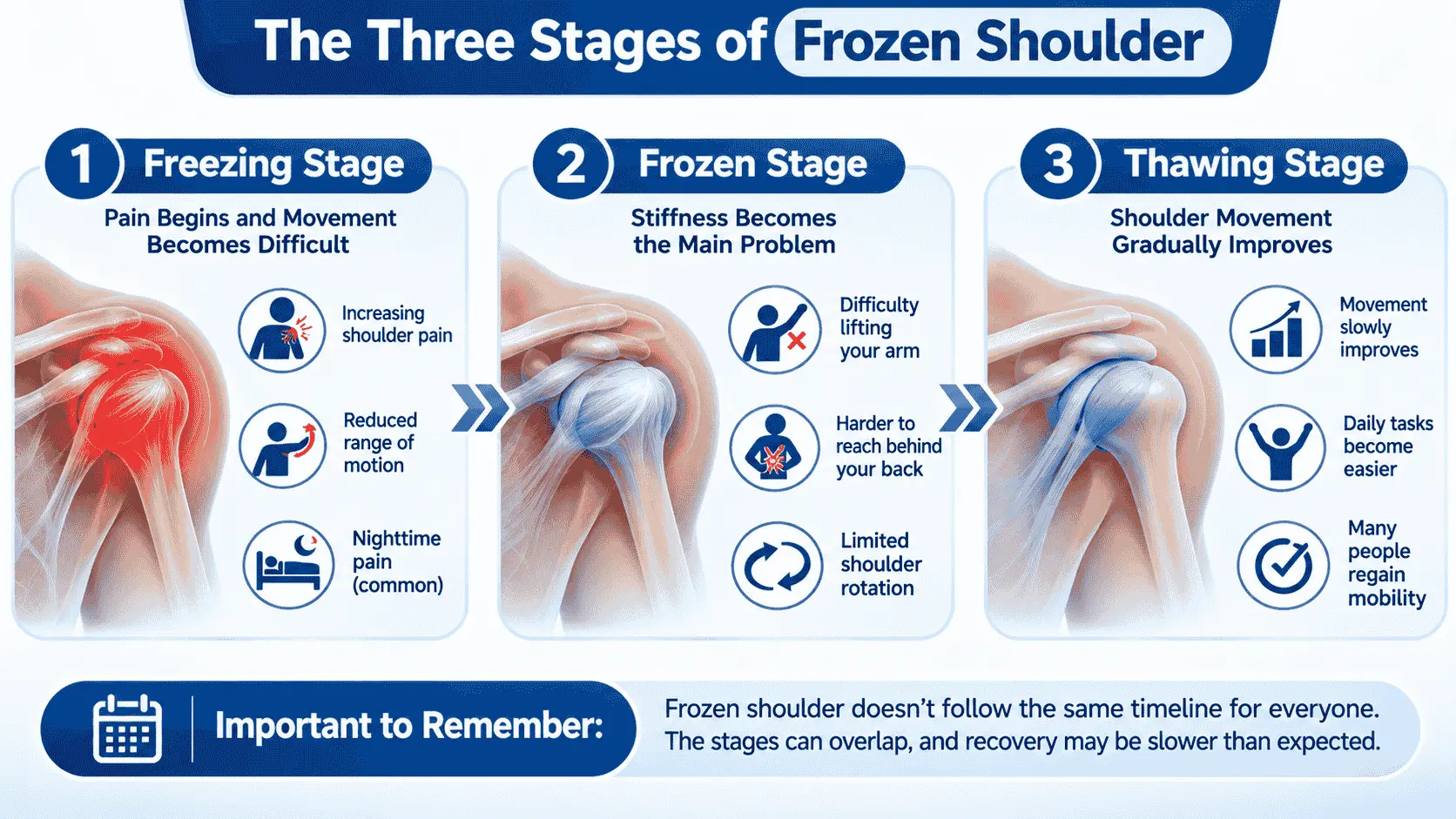
1. Freezing Stage: Pain Begins and Movement Becomes Difficult
During the freezing stage, shoulder pain gradually increases, and your range of motion begins to decrease.
You may notice that simple movements, such as reaching for a seatbelt or washing your hair, become uncomfortable.
Nighttime pain is also common.
This stage often lasts several months, but the timeline varies.
2. Frozen Stage: Stiffness Becomes the Main Problem
As the condition progresses, the pain may become less intense, but stiffness often remains significant.
You might find it difficult to lift your arm, reach behind your back, or perform activities that require shoulder rotation.
Even if your shoulder hurts less than before, restricted movement can still affect your daily life.
3. Thawing Stage: Shoulder Movement Gradually Improves
During the thawing stage, your shoulder slowly begins to regain movement.
Tasks that once felt difficult may become easier, although improvement is often gradual.
Some people recover much of their previous mobility, while others continue to experience some stiffness.
The important thing to remember: Frozen shoulder doesn’t follow the same timeline for everyone. The stages can overlap, and recovery may be slower than expected.
Why Does My Shoulder Hurt? Is It Always Frozen Shoulder?
Not necessarily.
If you’ve been asking yourself, “Why does my shoulder hurt?”, frozen shoulder is only one possible explanation.
Several other conditions can cause similar discomfort.
Shoulder Bursitis
A bursa is a small fluid-filled sac that helps reduce friction between tissues.
When a bursa around the shoulder becomes irritated, it can cause pain, especially when lifting your arm.
People searching for information about bursitis and shoulder pain may notice symptoms that overlap with frozen shoulder.
However, bursitis often causes pain with certain movements, while frozen shoulder typically produces a more widespread restriction in shoulder movement.
Rotator Cuff Problems
Your rotator cuff is a group of muscles and tendons that helps stabilize and move your shoulder.
Injuries or irritation in these tissues can make reaching overhead painful or difficult.
Unlike frozen shoulder, some people with rotator cuff problems can still move their arm through a wider range when someone else assists them.
Shoulder Arthritis
Arthritis can cause pain, stiffness, and reduced movement in the shoulder joint.
Because these symptoms can resemble frozen shoulder, a healthcare professional may recommend imaging or other examinations to help distinguish between conditions.
Shoulder Injuries and Fractures
If your pain began after a fall or accident, a shoulder injury is another possibility.
Common shoulder injury symptoms include pain, swelling, bruising, weakness, and difficulty moving the arm.
A broken shoulder can be very painful, but the severity varies. If you suspect a fracture, avoid forcing the shoulder to move and seek prompt medical assessment.
What Causes Frozen Shoulder and Who Is Most at Risk?
The exact reason frozen shoulder develops isn’t always clear.
Sometimes, it appears without an obvious injury. In other cases, it develops after a shoulder injury, surgery, or a period when the arm hasn’t been moving normally.
Certain factors are associated with a higher risk, including:
- Age: Frozen shoulder is more common in adults between approximately 40 and 60.
- Diabetes: People with diabetes have an increased risk of developing frozen shoulder.
- Thyroid conditions: Both underactive and overactive thyroid disorders have been associated with the condition.
- Shoulder immobilization: Keeping the shoulder still for an extended period after an injury or surgery may increase the risk.
Having one of these risk factors doesn’t mean you’ll develop frozen shoulder.
And if your shoulder has become painful or stiff, it doesn’t automatically mean you have adhesive capsulitis.
How Is Frozen Shoulder Diagnosed?
If your shoulder has been getting progressively stiffer, a healthcare professional will usually begin by asking about your symptoms.
They may want to know when the pain started, which movements are difficult, and whether you’ve had a previous shoulder injury.
During the examination, they’ll assess how far you can move your arm yourself and how far it moves when assisted.
With frozen shoulder, both types of movement are typically restricted, especially rotation.
An X-ray or other imaging test may sometimes be recommended to rule out arthritis, fractures, or other conditions. MRI isn’t routinely necessary for every case.
The goal is to identify the cause of your symptoms before choosing treatment.
What Helps Frozen Shoulder Pain and Stiffness?
When your shoulder hurts every time you move it, it’s tempting to stop using your arm altogether.
But keeping it completely still for long periods may contribute to further stiffness.
The right treatment depends on your symptoms, the stage of the condition, and your overall health.
Physical Therapy and Guided Movement
Physical therapy is commonly used to help maintain or gradually improve shoulder movement.
A physical therapist may recommend gentle mobility exercises, stretching, and later strengthening, depending on your symptoms.
The aim isn’t to force your shoulder through pain. It’s to work within a suitable range while gradually improving function.
Pain Management
A healthcare professional may recommend appropriate pain-relieving medication or other measures to help manage discomfort.
In some cases, a corticosteroid injection into the shoulder joint may provide short-term pain relief and make rehabilitation more comfortable.
These options should be discussed with a qualified medical professional, particularly if you have diabetes or other health conditions.
Other Medical Treatments
If symptoms remain severe or movement is significantly restricted, a specialist may discuss additional treatments.
These can include procedures such as hydrodilatation, manipulation under anesthesia, or arthroscopic capsular release in selected cases.
Not everyone needs these interventions, and treatment decisions depend on individual circumstances.
What Frozen Shoulder Therapy Exercises May Help?
If you’re looking for frozen shoulder therapy exercises, it’s important to remember that gentle, controlled movement is usually more appropriate than aggressive stretching.
Exercises should be adapted to your pain level and stage of recovery. Movements that repeatedly cause significant pain may aggravate symptoms.
Here are three commonly used exercises.
1. Pendulum Exercise
Stand beside a table or chair and support yourself with your unaffected arm.
Lean forward slightly and allow your affected arm to hang comfortably.
Gently move your arm in small circles or forward-and-back motions.
The movement should come mainly from your body rather than forcing your shoulder muscles to work.
2. Assisted Forward Elevation
Lie on your back or sit comfortably.
Use your unaffected arm to help guide your affected arm upward within a comfortable range.
Move slowly and stop if you experience sharp or increasing pain.
This exercise may help maintain shoulder mobility without requiring the affected arm to do all the work.
3. Gentle External Rotation
Keep your elbow close to your side and bent at approximately 90 degrees.
Using a lightweight stick or similar object, gently guide your affected forearm outward with help from your other hand.
Move only as far as feels comfortable.
Important: These exercises are general examples, not a personalized rehabilitation plan. If you have severe pain, a recent injury, or a suspected fracture, seek professional advice before trying them.
How Long Does Frozen Shoulder Take to Heal?
One of the most frustrating parts of frozen shoulder is that recovery can take time.
Some people notice meaningful improvement within several months, while others experience symptoms for one to three years or longer.
The timeline depends on factors such as symptom severity, underlying health conditions, and individual response to treatment.
Although many people improve, not everyone regains their full previous range of movement.
If your symptoms aren’t improving, don’t assume you simply need to wait. A healthcare professional can review your diagnosis and discuss whether your treatment plan needs to change.
Can a Chiropractor Help With Frozen Shoulder?
If you’ve been searching for a frozen shoulder chiropractor, you may be wondering whether chiropractic care could help with your symptoms.
Frozen shoulder is a specific condition involving the shoulder joint capsule. It isn’t simply a spinal alignment problem.
There is limited high-quality evidence that chiropractic adjustments specifically treat or resolve adhesive capsulitis.
However, a chiropractor with appropriate training may assess associated musculoskeletal discomfort, review movement limitations, and help determine whether additional medical evaluation or rehabilitation is needed.
At VitalSpine Chiropractic, our approach is to understand your symptoms and consider whether conservative musculoskeletal care is appropriate.
For a suspected frozen shoulder, coordinated care with a medical professional or physical therapist may be particularly important.
When Should You See a Doctor for Shoulder Pain?
Shoulder pain that keeps returning, becomes worse, or starts limiting your daily activities deserves attention.
Arrange a medical evaluation if you notice:
- Increasing shoulder stiffness
- Difficulty lifting or rotating your arm
- Pain that regularly interrupts your sleep
- Persistent discomfort after an injury
- Weakness or reduced function that doesn’t improve
Seek urgent medical attention if your shoulder looks deformed after an injury, you cannot move your arm after a fall, or you develop severe pain with significant swelling.
If you experience pain in your shoulder upon inhaling, especially with chest pain, shortness of breath, sweating, or dizziness, seek emergency medical care. Pain linked to breathing isn’t a typical frozen shoulder symptom and can sometimes indicate a more serious condition.
Looking for Shoulder Chiropractic Care in Sanford, FL?
When shoulder pain starts affecting your sleep, work, and everyday movements, it’s understandable to want answers.
At VitalSpine Chiropractic in Sanford, FL, Dr. Michaelene Callahan, DC, provides personalized chiropractic care focused on spinal health, mobility, and musculoskeletal function.
With more than 20 years of chiropractic experience, Dr. Callahan works with patients experiencing a range of musculoskeletal concerns.
If you’re searching for a shoulder chiropractor in Sanford, FL, an evaluation can help determine whether chiropractic care is appropriate for your symptoms or whether medical assessment and rehabilitation should be prioritized.
If you suspect frozen shoulder, getting the right diagnosis is an important first step.
Struggling with shoulder pain or restricted movement?
Contact VitalSpine Chiropractic to discuss your symptoms and arrange an appointment in Sanford, FL.
Final Thoughts
Frozen shoulder can turn simple movements into everyday challenges, from reaching for your seatbelt to getting dressed in the morning.
Understanding what frozen shoulder is, recognizing its symptoms, and knowing the available treatment options can help you make informed decisions.
Recovery often takes time, but appropriate assessment, pain management, and guided rehabilitation may help improve comfort and movement.
If your shoulder is becoming increasingly stiff or painful, don’t ignore the changes. Getting it checked can help you understand what’s happening and what to do next.
Frequently Asked Questions
1. Can frozen shoulder affect both shoulders?
Yes. Frozen shoulder usually affects one shoulder at a time, but some people develop the condition in the other shoulder later. Having frozen shoulder in both shoulders simultaneously is less common.
2. Can frozen shoulder come back after recovery?
Recurrence in the same shoulder is uncommon, but it can happen. Some people may also develop frozen shoulder in the opposite shoulder, particularly if they have associated risk factors.
3. Is heat or ice better for frozen shoulder?
Both may provide temporary comfort. Some people prefer gentle warmth before mobility exercises, while others find a cold pack helpful after activity. Use a protective cloth and avoid extreme temperatures.
4. Should you sleep on a frozen shoulder?
Sleeping directly on the painful shoulder may increase discomfort. Try lying on your unaffected side or on your back, with pillows supporting your affected arm.
5. Can frozen shoulder cause neck pain?
It can contribute to neck and upper-back discomfort because people sometimes change how they move their shoulder or hold their posture. However, neck pain can have other causes and should be assessed if it persists.
Medical References
- AAOS OrthoInfo — Frozen Shoulder
- NHS — Frozen Shoulder
- Mayo Clinic — Frozen Shoulder
- NHS — Shoulder Pain
Medical Disclaimer: This article is for educational purposes only and does not replace professional medical advice, diagnosis, or treatment. Consult a qualified healthcare professional for persistent shoulder pain, stiffness, or suspected injury.